

Planning for Equity on the Path to an IPO
July 16, 2026
The IPO market has gained meaningful momentum entering 2026, following several years of delayed offerings and cautious investor sentiment. While activity has improved and investor appetite has broadened across sectors, IPO windows remain selective and can shift quickly based on macroeconomic, geopolitical, and valuation dynamics. For private companies, this creates renewed urgency to prepare compensation programs, equity strategies, governance practices, and board education before a liquidity event becomes imminent. The core compensation considerations remain largely the same, but the 2026 environment places greater emphasis on readiness, flexibility, and disciplined equity use.
Private companies preparing for a liquidity event are reviewing their compensation philosophies and overall corporate reward structures. Considerations include:
- Salary structure design
- Equity strategy development
- Job architecture and leveling development
- Employee value proposition
- Incentive pay design, including equity guidelines
- Pay equity analysis
In addition, pre-IPO companies need an understanding of institutional investors’ requirements, SEC compliance, and peer development. They must also create a compensation transition strategy and educate the board of directors.
In 2026, the focus for many pre-IPO companies is shifting from whether the IPO market will reopen to whether the company is prepared to act when the appropriate window emerges. Companies should pressure-test equity plan capacity, dilution, grant practices, and transition timing so compensation programs can support both private-company retention needs and public-company investor expectations.
What If a Liquidity Event Isn’t on the Horizon?
Closely held companies and family-owned businesses understand they need equity opportunities to attract and retain talent. These awards are generally cash-settled opportunities tied to appreciation in the value of the company’s stock, and the payout is cash at vest, retirement, or when another condition is met. Phantom stock, stock appreciation rights (SARs), or cash-settled restricted stock units (RSUs) are most typical. These programs balance the controlling shareholders’ desire to limit actual equity awards to a few participants and to drive long-term appreciation opportunities. Awards that are equity-settled are generally subject to restrictions giving the company a right of first refusal to repurchase the shares.
Equity Practices When a Liquidity Event Is Expected
Life science, biotech, and emerging technology companies that expect a future liquidity event (IPO and M&A) typically use equity awards to attract and retain talent from day one. Award opportunities are directly tied to companies’ business plans and future share appreciation. These companies typically design pay to include competitive base salary and annual incentives; however, without a significant equity opportunity, they are not competitive. It is expected that these awards will lead to wealth accumulation opportunities for participants. The general design of these awards is:
- Opportunity value is a percentage of the company
- Grant is at date of hire
- Vesting is four years
- Vesting accelerates upon a change in control (CIC)
- Additional award opportunities arise in three to five years, based on business strategy
Stock Options Are Common for Companies on a Path to IPO
For most pre-IPO companies, the preferred equity vehicle is stock options. Award opportunities and design are influenced by several competing factors:
- Candidates for highly specialized roles, particularly in AI, data infrastructure, advanced engineering, and other scarce technical disciplines, may have leverage in compensation negotiations and can demand above-market grants
- For most other positions, the employer defines the opportunity and harmonizes it across employee level and location
- Equity strategy is influenced by investors’ focus on dilution
- Equity grant differentiation, whether by award type or individual, is key to managing equity spend and employee expectations
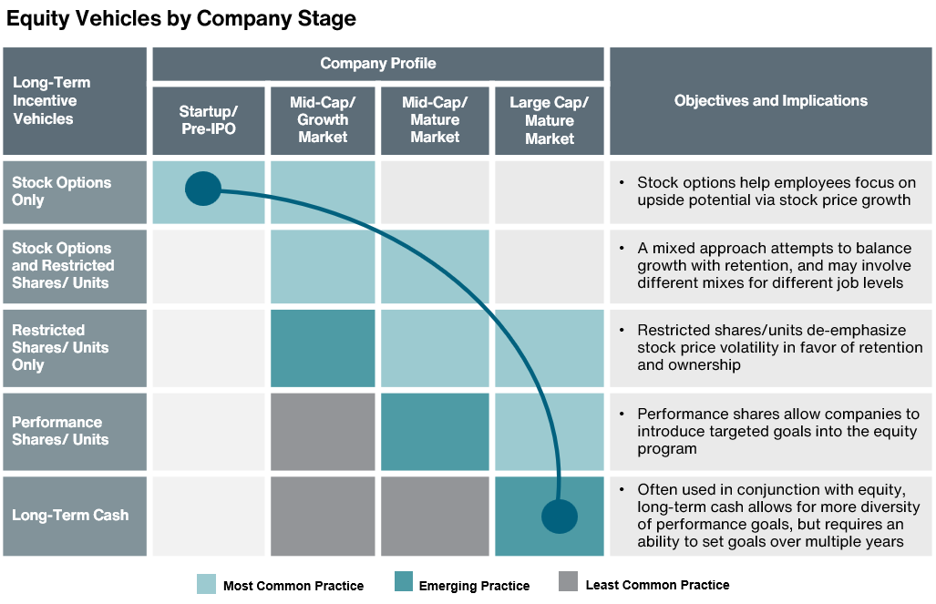
As late-stage private companies mature, they may also evaluate whether a stock-option-dominant approach remains effective for all employee populations. Depending on valuation, retention objectives, liquidity expectations, and available share pool capacity, some companies may introduce RSUs or a more differentiated mix of equity vehicles before or around the IPO transition.
As the IPO or other liquidity event becomes closer, equity professionals need to understand how award design will change. Public-company design has significant differences, including award opportunity, frequency of grants, vehicle type, and eligibility.
Key Considerations for Equity Plans as a Company Matures
- As companies mature, their approach to equity evolves
- Late-stage, high-valuation private companies may consider a transition to a public-company approach prior to IPO
Award Size
Private Philosophy
- Established based on a target ownership percentage
- Measured cumulatively at a given point in time
Public Philosophy
- Equity grants are established based on a target dollar value delivered annually, converted to a number of options or shares based on the current stock price
New-Hire vs. Ongoing/Refresh
Private Philosophy
- Large new-hire grant
- Refresh grants delayed until IPO approaches, or three to four years after hire
- Refresh guidelines set anywhere from 25% to 35% of new-hire awards
Public Philosophy
- New-hire awards are typically twice the size of ongoing awards
- Most employees are eligible for an ongoing award after one year of service
Vehicle Mix
Private Philosophy
- Stock options predominantly
Public Philosophy
- Mix of stock options and RSUs
- Emphasis shifts toward RSUs as the company matures
- Prevalent use of performance shares for executives
Participation
Private Philosophy
- New hires: nearly 100%
- Refresh awards: Targeted at key performers and those employees greater than 50% vested
Public Philosophy
- New hires: Participation decreases as company increases in size
- Ongoing awards: Broad eligibility is maintained, although awards are targeted at top performers, with 40% to 60% of the population receiving grants annually
When Liquidity is Delayed
Even in a more active 2026 IPO market, liquidity timing can remain uncertain. Companies may still delay an IPO because of valuation expectations, market volatility, investor selectivity, or strategic considerations. As noted, stock options remain market-prevalent for pre-IPO companies; however, as the private-company period extends, other awards and liquidity alternatives should be considered. Several equity design issues occur when an IPO is delayed:
- Share pool reserves run low, and continuing to grant stock options will further dilute the pool
- Initial awards are fully vested, and top-off awards are limited because of the reduced share pool
- Reduced share appreciation is not creating wealth opportunities for recent hires
As such, companies that are still private and planning for a future IPO often begin to evolve their equity award philosophies to align with more mature companies, recognizing that accelerated share appreciation, unlimited share pool capacity, and one-size-fits-all option grants may no longer be realistic. The objective is to preserve retention value, manage dilution, and maintain flexibility so the program can transition efficiently when a public-company path becomes actionable.
Another influence on equity design is the ability of participants to “cash out” while the company is still private. Even with more constructive IPO conditions, many companies continue to use secondary liquidity or tender offers to bridge timing, address employee expectations, and provide selective liquidity before a public listing. A tender offer is an arrangement where shares are sold to outside investors; the prearranged trade at a fixed price provides liquidity for employees while allowing the company to further delay the IPO. Although still private, the company may begin to adopt “post-IPO” equity design concepts as noted above. Once the company does go public, significant changes to equity award vehicles and opportunities are expected.
For more resources, visit the Private Company Stock Plans section on NASPP.com.-

By Nicholas AdamsEquity Services Consultant
Aon
-

By Derrick NeuhauserAssociate Partner
Aon