

Managing Global Tax Withholding for Equity Awards
July 15, 2026
When a company finds itself in trouble with regulators, it’s often due to a tax issue. Tax authorities around the globe can be aggressive in monitoring compliance, and the penalties for failures can be financially hefty, and sometimes criminal.
When equity plans are multinational, the factors involved in ensuring proper tax withholding can multiply. This blog entry explains the most common approaches to managing global tax withholding of equity awards.
How to Determine the Best Withholding Method
Figuring out which tax withholding method or methods may work best for your equity plan is not a one-size-fits-all approach. Here are the more common choices:
- Withhold from wages: The stock plan administration team reports equity transactions to local payroll teams, which then determine income and related tax withholding and deduct the taxes due from employees’ regular wages.
- Sell-to-cover: The employee sells enough shares to cover the tax withholding due on the award.
- Share withholding: Also known as net issuance or withhold-to-cover, in this approach, the company holds back shares from the equity award with a value sufficient to cover the tax withholding due.
- Cash remitted by employee: The stock plan administration team reports equity transactions to local payroll teams, which then determine income and related tax withholding and collect a cash payment from employees to cover the taxes due.
Several variables can influence the decision on which methods to use. Among them are the type of award, the company’s cash flow considerations, trading windows, and stock volatility. It may be appropriate to use different withholding methods for different types of equity vehicles. Withholding taxes from wages might make sense for ESPP purchases, while share withholding or sell-to-cover might be more feasible for RSUs.
Determine the Appropriate Withholding Rate for Equity Awards
In the United States, equity compensation is treated as a supplemental payment and is eligible for withholding at a flat rate. Few other countries have a flat tax rate. Instead, most countries require that taxes on equity awards be withheld at the rate that applies to an employee’s regular wages.
In practice, however, determining this rate may be challenging. In countries with graduated or progressive tax rates, the rates that apply to individual employees may vary widely. In some cases, income from equity transactions could move employees into a new tax bracket, causing their withholding rate to increase.
One solution to this challenge is to withhold taxes at the top marginal rate in each country. This reduces the number of tax rates the stock plan administration team must track to just one per country.
When this method is used, any excess withholding is generally refunded to employees through their local payroll, which effectively trues up the withholding to the individual rates applicable to each employee. This ensures compliance with local tax laws. Moreover, in many countries, employees do not file tax returns. Refunding the excess withholding through payroll may be the only way to ensure employees don’t overpay the taxes due on their equity transactions.
There are several downsides to withholding at the maximum tax rate:
- Employees could be due significant refunds because of over-withholding.
- When shares are used to satisfy tax withholding , such as sell-to-cover or share withholding, applying the highest marginal tax rate means employees receive fewer shares.
- When shares are sold to cover the taxes, using the highest marginal tax rate increases the number of shares sold into the market.
- When shares are withheld to cover the taxes, using the highest marginal tax rate increases the company’s cash outflow.
Pro Tip:
Verify that plan language supports withholding at a maximum rate.
Some plans require tax withholding at no more than the statutory minimum. If so, the plan must be amended before the company can withhold taxes at a higher rate. This amendment typically can be accomplished with board approval alone and would not generally require shareholder approval.
Alternatives to Withholding at the Maximum Tax Rate
Although collecting taxes based on a maximum rate ranks high on the easy-to-implement-and-manage spectrum, the potential impact on employees may be reason to consider alternatives. Some other approaches to evaluate are:
Exact Rate: In this approach, taxes are withheld at the exact rate that applies to each individual employee, as supplied by local payroll teams. This can result in very accurate withholding and is especially viable when the parent entity receives automated payroll data feeds from its various localities, and when dealing with only a small number of countries. Without automation, or if the participant population is spread across many countries, this approach could be tricky to maintain.
Hybrid Approach: In this approach, the stock plan administration team, in coordination with local payroll teams, establishes a few rates , for example, two per country, that span the minimum-to-maximum spectrum of liability for each jurisdiction. Taxes are withheld at the rate that most closely aligns with each employee’s anticipated income for the year.
This approach can result in more accurate withholding than the maximum rate approach, with fewer refunds, all while satisfying withholding requirements. It can be particularly helpful in countries where the maximum marginal income tax rate is exceptionally high and applies to a relatively small population of employees.
Pro Tip:
If you use a hybrid approach, use an annual process to assign tax withholding rates to employees. The rate assignment should be based on the employee’s expected income, including salary, bonus, equity, and anything else required to be factored in per local regulations.
Survey Data on Global Tax Withholding Approaches
Over half of respondents to the NASPP/Deloitte Tax 2025 Equity Administration Survey set a flat rate by country to withhold taxes on equity awards held by participants located outside their headquarter country.
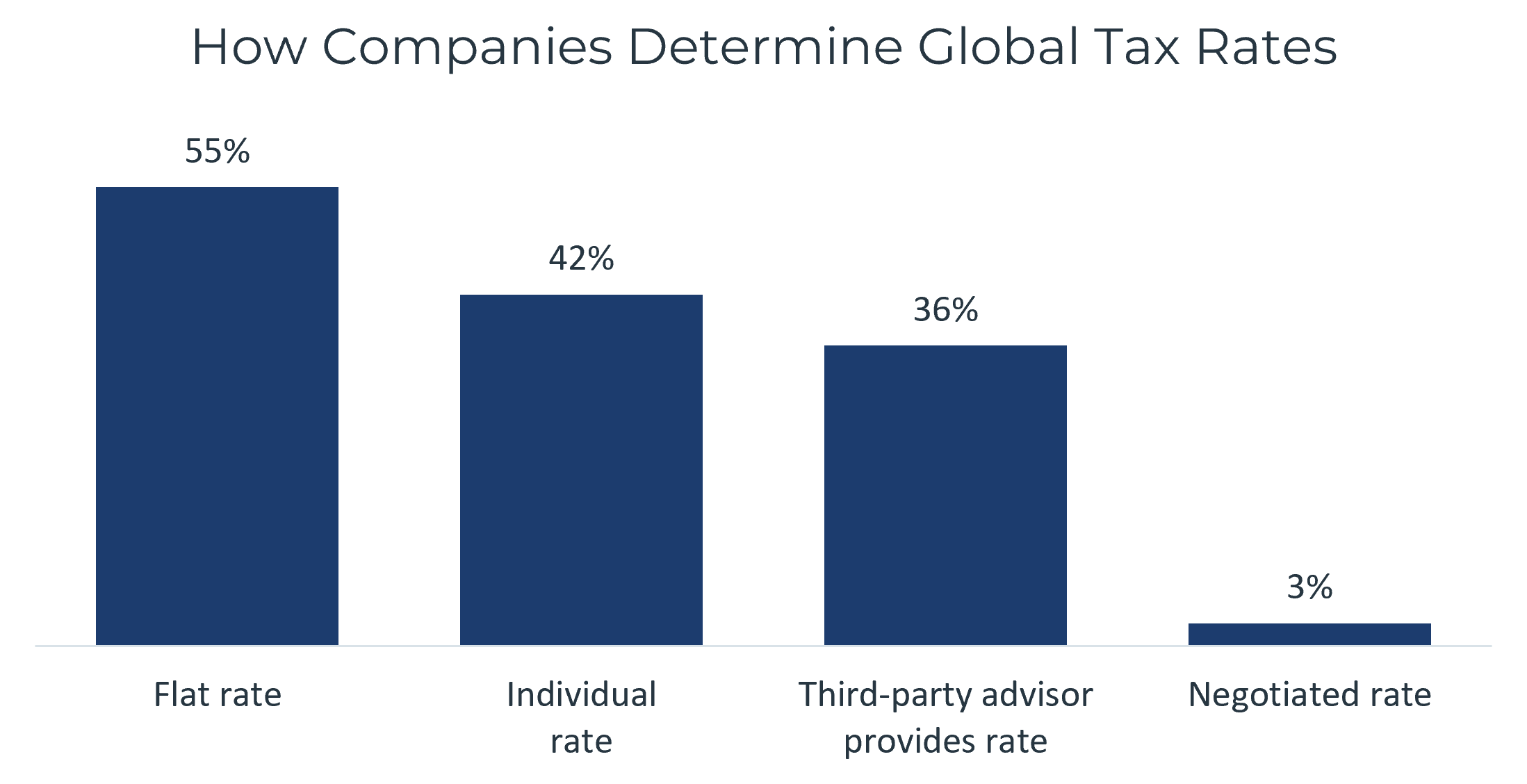
Most of these companies (74%) use the maximum individual tax rate in the country. Nearly 90% have their local payroll teams true up the withholding to employees' individual tax rates in some or all countries. Just over 40% withhold taxes at individual tax rates. Note that this question in the survey allows for multiple responses: some companies may vary their approach by country.

Learn More About Equity Compensation Tax Compliance
Ready to strengthen your global equity compensation strategy? Explore the NASPP course Taxation of Equity Compensation Essentials to build your team's expertise.
Want more insight into how peer companies handle tax withholding? Watch the NASPP webinar on equity award tax withholding trends and best practices.
-

By Barbara BaksaExecutive Director
NASPP