

Equity Compensation Dilution: Private Company Guide
May 14, 2026
Understanding Dilution for Equity-Based Compensation in Private Companies
Issuing equity compensation such as stock options, phantom shares, profits interests, restricted units or appreciation rights means employees will share in the equity value of the company. This feature is central to most plans, and its impact on existing shareholders is referred to as dilution. Dilution represents the portion of total equity being provided to employees.
Equity compensation plans in private companies create two types of dilution. The first component, ownership dilution, occurs because more equity interests will be outstanding. Granting equity compensation reduces the ownership percentage held by existing shareholders. The second component, value dilution, occurs because the company’s total equity value is spread across a larger number of equity related interests. Issuing equity compensation divides the value of the company among more shareholders and more shares outstanding, which reduces value per share.
Together, ownership dilution and value dilution combine to produce the total shareholder dilution of equity compensation. The number of units issued and the value of those units work together to define the dollar value of equity that is being given to the equity compensation plan.
A clear understanding of total shareholder dilution and how it is measured is important because it is used to:
- Assist with plan design
- Establish fairness to shareholders
- Benchmark reasonable compensation
- Support financial reporting
- Assist communications with stakeholders
Ownership Dilution: How to Calculate Share Impact
Establishing ownership dilution is relatively straightforward. Most equity compensation plans have units that relate to, or are connected with, common shares. Ownership dilution is calculated by taking the number of common share equivalents represented by the equity compensation and dividing it by the total fully diluted common share equivalents of the company. For this purpose, total common share equivalents include all forms of equity compensation and other applicable interests as if they were hypothetically converted or exchanged into common shares, including the equity compensation interests.
For this calculation, the equity compensation unit count includes only issued and outstanding equity compensation. It excludes any pool of authorized but unissued units because value cannot be established on these units until granted. The total common share equivalents outstanding also include equity related interests that can become common shares, such as warrants, convertible financial interests or participating preferred shares. Ownership dilution is just basically the percentage of total ownership being granted to employees.
For example, if a company grants 25,000 stock options and has 100,000 common shares and 1,000,000 convertible preferred shares, the percentage dilution is 25,000 divided by 1,125,000, or 2.2%.
Value Dilution: How Award Types Affect Equity Value
Determining value dilution is more complex because the amount of value dilution depends on the type of unit. Equity compensation issued by private companies generally falls into two categories: full value awards and appreciation awards. Each category has a different impact on value dilution.
Full-Value Awards: 100% Dilutive
Full value awards include grants such as phantom units, restricted stock, or common shares. These units provide the employee with the full value of the underlying share. Full value awards are 100 percent dilutive to total equity value.
For example, if a company grants 100,000 restricted stock awards and the corresponding common stock is worth $1.00 per share, the basic dilution to total equity value is 100,000 multiplied by $1.00, which equals $100,000. As a result, total equity value available to existing common shareholders declines by $100,000.
Dilution from full-value awards is proportionate to ownership (percentage) dilution. If full-value awards represent 5 percent of fully diluted common ownership, value dilution will also be 5 percent of total common equity value. As the value of the underlying share increases or decreases, the value of fully dilutive equity compensation interests changes accordingly by the same factor.
Appreciation Awards: Less Than Fully Dilutive
The other broad category of equity compensation in private companies is appreciation awards. Appreciation awards include units such as stock options, profits interests, or share appreciation rights (SARs). These awards provide value to the employee only when the corresponding share increases above a benchmark. For example, stock options are issued with a specified exercise price per share and have value to the employee only if the stock price increases above that benchmark.
The value of an appreciation award is typically determined using an option-based method such as the Black-Scholes equation, OPM backsolve, Monte Carlo simulation or a binomial model. These methods incorporate the possibility of changes in value, where the underlying share value could be higher or lower than the benchmark in the future.
Because appreciation awards have a benchmark, they typically have a lower value than the full value of the corresponding share. This is because the award does not participate in value below the benchmark. For units such as stock options and SARs, the benchmark is typically the common share price at the grant date. For profits interests, the benchmark is set by a threshold based on the company’s total equity value at the grant date.
As an example, using a typical option-based valuation method, the value of a stock option might be 30 to 70 percent less than a full-value award. Because the per unit value is lower, appreciation awards are less dilutive than full value awards, even if the same number of units are issued.
When compared with the value of the corresponding share, value dilution from appreciation awards relative to the underlying share is expected to change over time. For example, if the common share value falls below the benchmark, the value of a unit and shareholder value dilution decline. Conversely, as the common share value rises above the benchmark, the value of the unit and shareholder value dilution increase. While an appreciation award’s value could be zero, it cannot exceed the full value of the corresponding interest.
Vesting Conditions: How Vesting Can Affect Value Dilution
Vesting conditions can also affect value dilution. The possibility that units might not vest, and no value be received by the employee, may reduce the value of grants. There are three basic types of vesting to consider: service, business performance, and market conditions. Service conditions pertain to continued employment. Business performance conditions relate to achieving business objectives, such as earnings measures or developing a new product. Market conditions relate to achieving economic outcomes, such as a return to investors. In practice, business performance and market conditions are commonly both referred to as performance vesting conditions.
In private companies, the value of a unit is not adjusted for service conditions. Although an employee might leave the company and forfeit units, continued employment is typically presumed as a practical expedient because departures can be difficult to accurately predict. For performance conditions, unit value is adjusted for the possibility that the vesting condition may not be achieved. This adjustment is typically accomplished using an option-based valuation method that factors the condition in as a benchmark. As a result, the value of both full value and appreciation units will be reduced to reflect the possibility that the performance condition may not be achieved and a unit will not vest.
Waterfall Rights: How Capital Structure Can Reduce Value Dilution
Private companies backed by venture capital or private equity that issue equity compensation typically have a complex capital structure with multiple classes of shareholders, preferences and other rights defining a hierarchy of payouts to various equity interests. These rights and conditions are defined in shareholder agreements and are referred to as a waterfall.
Most equity compensation interests are at very junior or lowest levels relative to this waterfall. For employees, this means other shareholders are entitled to receive payments and value before equity compensation interests participate. Accordingly, the value of the company and level of these preferences could work to reduce the payouts for equity compensation interests. These risks in the waterfall structure can further reduce potential value to equity compensation interests. Measuring this effect from the waterfall is typically handled using an option-based valuation method.
Additional Private Company Adjustment: Marketability Discounts
Private companies typically require an additional step to accurately measure shareholder dilution from equity compensation. This step considers how the value of the equity compensation grant reduces total common equity and how that reduction affects both existing shareholders and equity compensation units.
This adjustment is generally not needed for public companies, where the market price of a common share is presumed to reflect the impact of all dilutive interests. In private companies, without publicly traded shares, this is not the case. Although subtle, making this adjustment is important to avoid overstating plan dilution.
For example, in a company with only common shares and equity compensation units (such as stock options), the process is to determine an initial value for the equity compensation, deduct that amount from total common equity, and then recalculate a new value per common share. That revised new value per common share is then used to revalue the stock options. This creates a new value of the stock options, changes shareholder dilution, and value per common share. This creates an iterative process that is repeated until the value per common share stabilizes, meaning additional repetitions do not materially change the results.
For a private company having a complex capital structure with a waterfall, preferences and multiple types of equity-related interests this stabilized value is typically achieved through the option-based valuation method used.
Discounts and DLOM: When Marketability Can Reduce Value
Another private company adjustment that can affect value dilution involves discounts. Equity compensation interests granted in private companies rarely have an established market, or a practical ability for employees to obtain liquidity. Even after vesting, employees are unlikely to receive cash or a payout until an exit, IPO, or other liquidity event, which may occur years later. Employees also bear risk because the unit value could change unfavorably during the holding period.
These conditions are described as a lack of marketability or lack of liquidity. As a result, equity compensation units typically have additional risk and lower value than units that can be readily sold. This creates a need to consider potential discounts, commonly referred to as a discount for lack of marketability (DLOM). Using a DLOM is a professionally recognized practice in tax and financial reporting. In some situations, it may be appropriate to assess value dilution without considering a DLOM, such as when equity compensation has a buy back or cash out program with the company.
Professional judgment is required to determine whether a DLOM is appropriate and, if so, the amount. When applicable, these discounts could range from 5% to more than 40% per share, depending on the facts and circumstances. Factors to evaluate include overall business risk, time until a liquidity event, waterfall structure, buyback provisions, equity features, and other relevant items. This adjustment may be qualitative, quantitative or a combination of those, and setting it often requires assistance from a qualified valuation professional.
How to Estimate Value Dilution in Practice
While ownership dilution can typically be calculated readily, equity value dilution is more difficult to establish. As noted above, many equity compensation units are tied to the value of a common share. In most cases, it is necessary to have an appropriate valuation of the common share.
Many privately owned companies obtain such valuations to support tax, financial reporting and equity compensation grants, often referred to as a 409A valuation (tax) or ASC 718 (US GAAP financial reporting). These valuations can also help establish value dilution of equity compensation, as they often provide values for all equity-related units. They also typically establish a common share value, which can be used as an input to value equity compensation units tied to that indicator.
In other situations the company may need a valuation analysis to support these activities. This may be performed internally, using valuation software, or by engaging an independent valuation professional.
Conclusion: Arriving at Total Shareholder Dilution
Once the number of units and their value are determined, units issued (percentage dilution) is multiplied by value per unit (value dilution) to arrive at total shareholder value dilution.
For example, let’s a assume a private company has a total equity value of $50 million, with 10 million common shares issued and outstanding, making the value per common share $5.00. There are no other equity related interests.
The company then creates a new equity compensation plan authorizing 1 million units of various types. The company then issues 300,000 phantom units and 300,000 stock options, both with service vesting conditions of 5 years. The stock options have an exercise price of $5.00 per share.
The table below summarizes a simple analysis of the shareholder dilution of this plan.
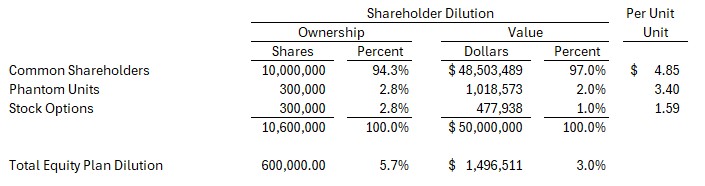
As shown above, this equity compensation plan creates the following:
- Equity plan ownership dilution: 5.7%.
- Equity plan total shareholder value dilution: 3.0%.
- Value of equity compensation plan: $1.5 million.
- Value per common share: $4.85.
As shown in this example, while the percent dilution is nearly 6%, the value dilution is about half that amount. And by comparison, the full value phantom units are at $3.40 compared to the appreciation based stock options at $1.59 per unit, making the stock options about 50 percent less dilutive per unit.
Illustrative assumptions include a DLOM of 25 percent for the options and phantom shares; Stock options with a 10 year expiration, 48% volatility, 4% risk free rate, expected term of 7.5 years; Results rounded for demonstration purposes only.
Although dilution from equity compensation can seem to have a negative impact to investors and shareholders because it reduces the value of their ownership, it is part of having a successful equity compensation plan. Existing shareholders give up some ownership for strategic purposes, with the expectation that equity compensation will provide incentives to help grow company value. When this approach is successful, all stakeholders end up with more value than would have otherwise been achieved without a plan.
For more resources, visit the Private Company Stock Plans section on NASPP.com.
-

By David HowellPrincipal
Plante Moran